What parents usually ask me
If your question isn't here, email me at hola@papaspro.com.
Did I already start too late?
It's never too late to open an opportunity for your child.
What changes with the months is where you start: before 18 months, from the dots — subitization (perceiving quantities at a glance) is active. After 18 months that window closes, and your child goes straight into the numerals and operations stage, which runs all the way to fractions. The bundle includes both paths.
Aren't they too little still?
It's the opposite: the younger they are, the easier it is. Your baby's brain is at its most receptive —and their ability to see quantities, directly and without counting, is wide open in these very months, and narrows afterward.
That's why this path begins at birth. I'm doing it right now with my baby Rōki, from his first weeks —just as I did with my older kids. I've been at this for years, and I'm choosing it again. The bundle even includes a Visual Maturation lesson made for those first days.
There's no need to wait for them to "be ready." Starting today is starting with the window open.
Do I need to be a teacher?
You don't need to be. You're already the expert on your baby: no one knows them more, or cares more, than you.
I tell you what to do each day and the tool carries the tedious part. You only bring what no one else can: your presence.
What if I barely have time?
Each session lasts seconds —under ten— and repeats a couple of times a day.
Time is the one thing a mom has least of. That's why the tool handles the material: you live those seconds present with your baby.
Aren't I pressuring them?
It's the most important question you can ask yourself.
Glenn Doman put it plainly: the purpose of giving a child encyclopedic knowledge is not to make Nobel Prize winners, or concert violinists, or Olympic stars, or geniuses of any sort. It is to give them unlimited options in life.
This is gymnastics for the brain: you open the opportunity and let it grow at their own pace, no testing and expecting nothing of them. The opportunity is in your hands; the result is theirs.
Isn't schooling this early a bad thing?
And you're right to be concerned: sitting a little child down to do handwriting drills, to stay still at a desk, to take tests before their development asks for it does harm, and there's research behind it.
What we do here lives in another world: seconds a day, in your arms, playing.
It's joyful exposure, at their pace, woven into play and into being with you.
How do I know it works if I don't test them?
There is no testing. Here we celebrate what is there.
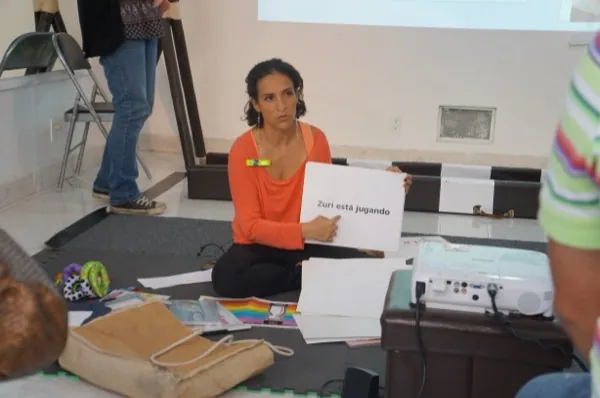
When she was little, Zuri wanted to show me everything. Then one day she stopped —she'd felt tested, and held it in. My husband Luis would say "she's forgotten it all"; I'd say "no, relax." I kept presenting, without asking.
And at two, almost three, it came back: she saw some words and told me, "remember when you used to show me these? This says such-and-such." From then on, nothing stopped her —she read every street sign she saw.
That's why, at the end of the day, there's one question, the only one in your hands: "did I give them the opportunity today?"
Why bother, if they won't even remember?
You don't remember when you learned to walk or to talk, and yet you do both every day without thinking. You learned the deepest things before you had any memory at all, and that's why they became part of you forever.
Your baby may not remember these sessions, but they'll remember having you close.
And they'll use that brain highway their whole life, without knowing when it was built.