Path 1
You save the page for the day you'll have time to make a hundred cards by hand and work all of this out on your own. That day comes when it comes, and meanwhile your baby keeps learning from everything they see.
For your baby it's a game: first they see how many things there are, and the symbol comes later. Under 30 seconds a day, from the first months.
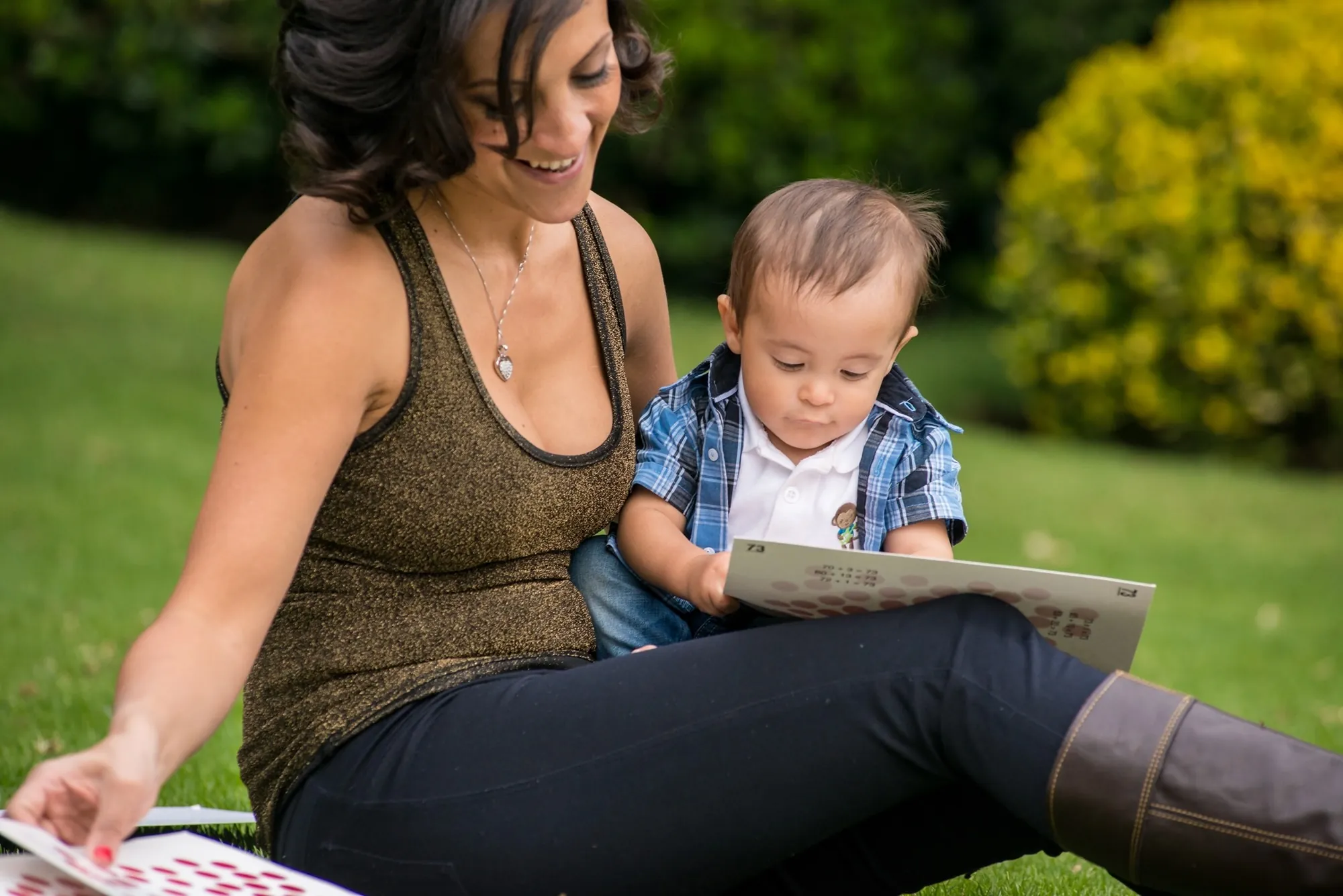
These early years are the most fertile season your child's brain will have, and there is no need to wait for school to use it.
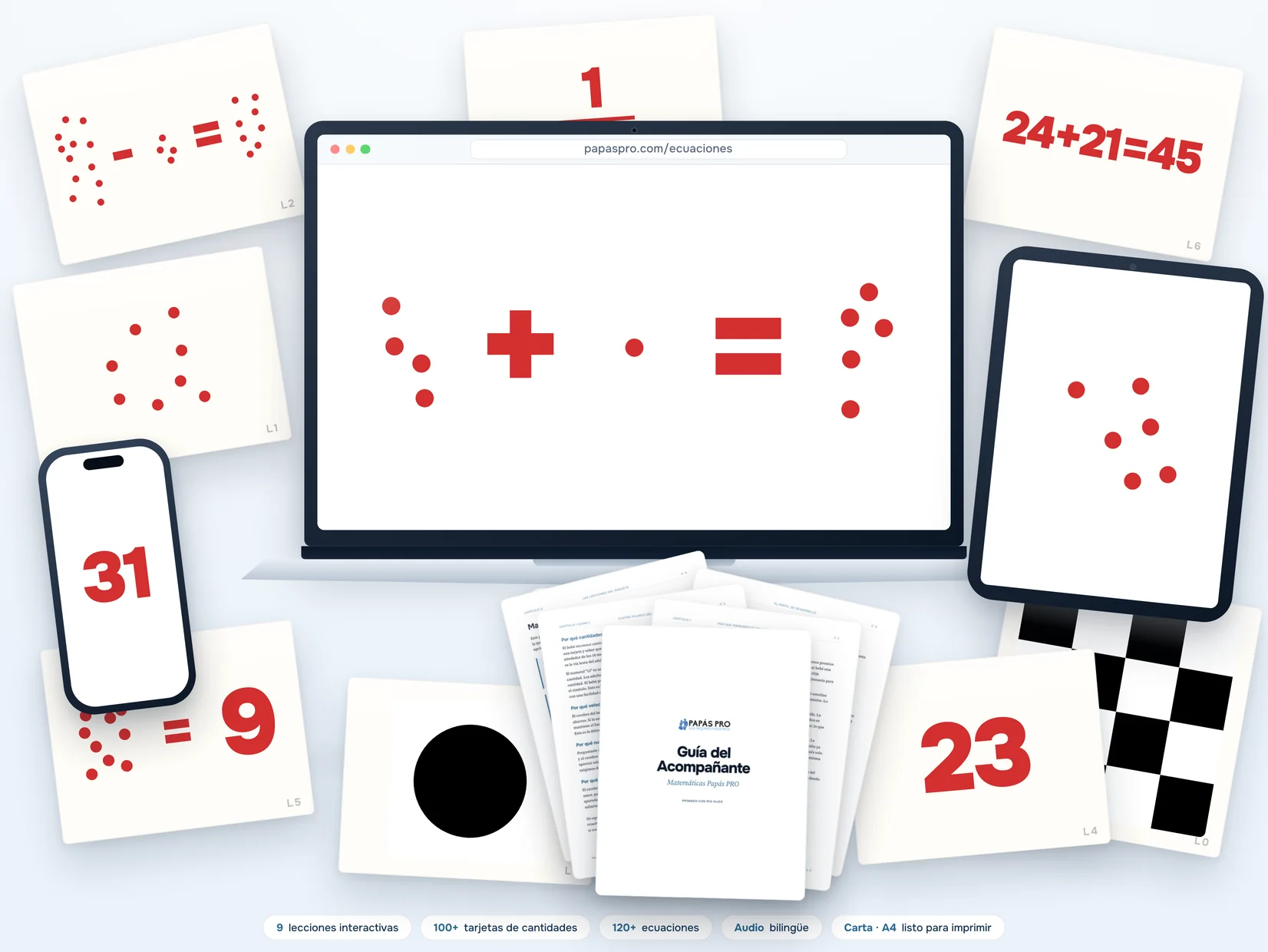
Math Papás PRO — Complete Bundle
Total value: $100 USD
Your price today$29 USD
You save $71 USD — 71% off the total value.
Available very soon.
My work has appeared in
You watch the way your baby stares at things: a light, a face, a pattern.
Their brain is in the season when it learns fastest, and you want to give that curiosity something worth its while: photographs, precise names and an order someone thought through.
You have the will. What's missing is a clear path —what to do, in what order, without slipping into pressuring your baby— built for this stage and fitting in thirty seconds a day.
That's what comes next.
new connections a baby's brain forms in the time you have been on this page
In the early years, your baby's brain forms more than a million new connections every second.
What gets used is reinforced and coated in myelin: that's how a connection goes from dirt path to brain highway. What goes unused, the brain prunes away.
It's the age when learning a quantity feels as natural to them as learning a face or a voice.
Your baby tells quantities apart before knowing the names of numbers. They see how many there are at a glance, without counting.
That window is wide open now, and it narrows with the months.
New neural connections per second: Institute of Education Sciences, U.S. Department of Education. Quantity perception in infants: Antell & Keating (1983); Izard et al., PNAS (2009).
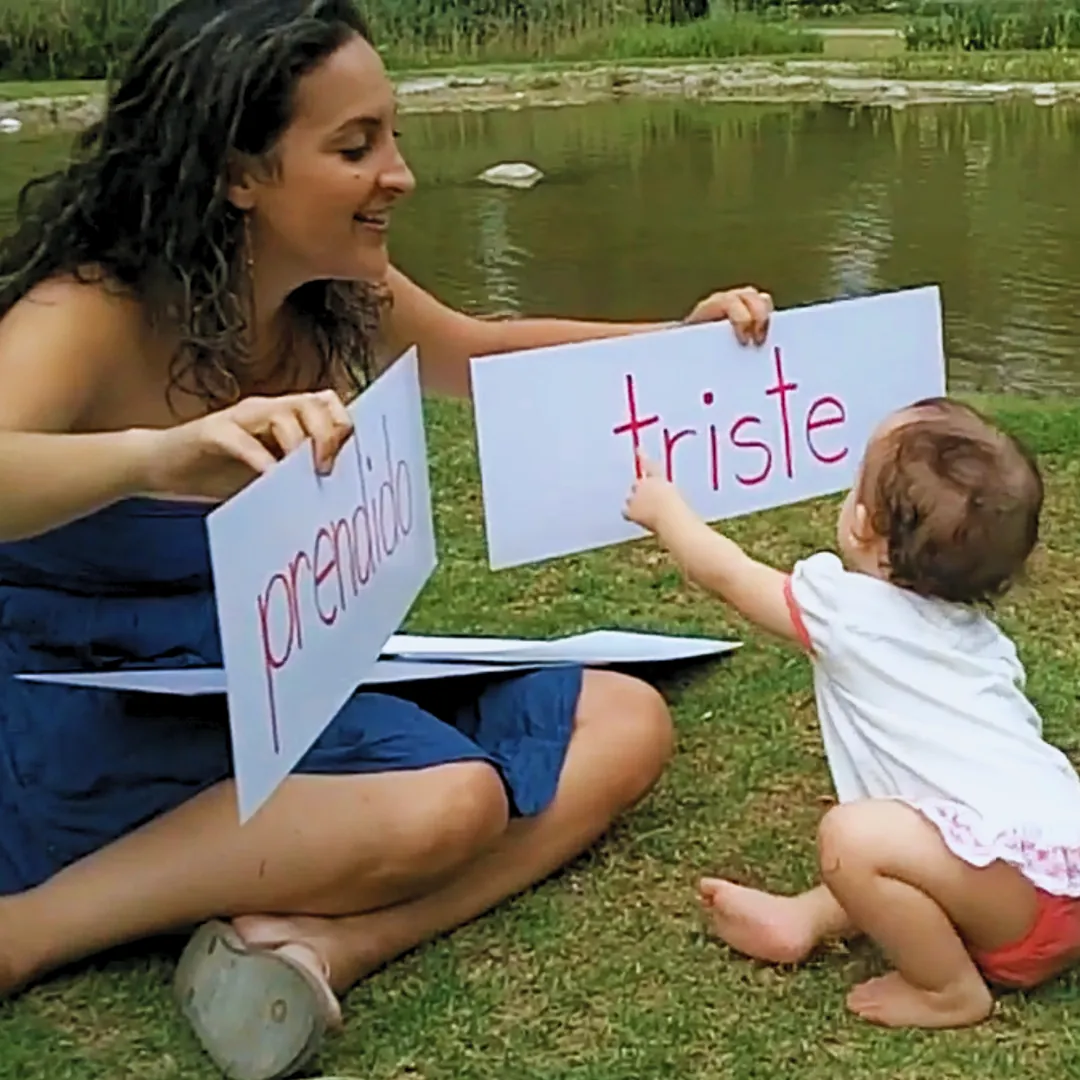
I'm an only child. Before becoming a mom I had never held a baby —they scared me, they cried. I had never changed a diaper in my life.
And then Zuri was born, premature. At one of the first checkups, the doctor told me we'd always have to adjust her age, that she'd be a few months behind the other kids.
"Behind?" I thought. "I don't think so."
I'm an engineer, so I did the one thing I knew how to do: go to the source. I wanted to understand how a baby's brain develops. I read, I studied, I trained at the Institutes for the Achievement of Human Potential, in Philadelphia, which is where this work is taught to parents.
What I found was a weave of three traditions: Glenn Doman's cards, Montessori's respect for the child's pace, and the freedom to let them follow their curiosity. He laid out the math side in "How to Teach Your Baby Math" back in 1979. I started applying it at home with Zuri, playfully, in sessions of seconds.
I showed her words. I read to her constantly. And one day, tiny, she started to read —to her it was a game, I never sat her down to learn her vowels. By a bit over three she was reading whole little books, on her own.
That's when it hit me: this is how children learn. Their brain does in three years what would take an adult a lifetime —learning a whole language, with no accent, without a single class.
And it wasn't just Zuri. With Ian and Maya I did it from day one. Ian, in particular, loved the dots. I taught all three sign language —they talked to me with their hands before they could with their voices. And the loveliest part: each one showed me who they were so early, through the bits they chose to look at —the picture cards I showed them—, their personality peeking out in whatever drew them in.
And the hardest part of all was unlearning, myself. So many of us were raised to believe we can't be trusted; that's why it's so hard to trust that a child can take the lead in their own learning.
When I started sharing this —over a decade ago— some attacked me: that I did it for ego, that I was robbing my daughter of her childhood. They said it then and they say it now. What I see is that I opened doors for her. For her it was always a game, and that delight in learning is what will last her a lifetime. Today I see it in Zuri, in Ian, in Maya —in the ease with which they learn anything new, in how much fun it all still is to them, in how they move through the world.
It worked so well that, fifteen years later, with my youngest baby, I'm doing it all over again from his first weeks. Knowing everything I know now, I'd choose it again.
And from the very first day I documented everything I did —at first for myself, because explaining it helped me understand it; and because I would have loved to find someone who had already walked the path, so I wasn't left wondering whether this worked.
That's exactly what I want to be for you. Into this bundle I put everything I learned —first from studying, then from practice with my own kids—: what to show your baby, in what order, and how long to keep going, already worked out. You just follow it.
So you don't have to start where I started: scared, alone, googling at midnight, wondering whether what you're doing works.
Doing it by hand means 5,050 dots glued across a hundred cards before the first session — and then tracking, every day, which ones your baby has seen, which to retire, and which to add today. That's where I got stuck.
The tool does all of that grunt work for you. It shows the cards on the screen, in a different order each time —as suits their age. You don't have to keep track: the lesson knows which ones you've already shown, which to retire and which to add today, and rotates them on its own. It says each number out loud as your baby watches. It never drops a dot.
The one thing it doesn't do for you is be there. That part is yours: holding your baby for the under-ten seconds the session lasts. And that's exactly what matters.
Turn on silent mode and say them yourself. The tool shows you a small reference numeral in the lower-right corner, so you never lose your place — not even at 98.
The printable PDFs —100 quantity cards, 100 numerals and 120 equations— are included. You decide whether to print, what to print, and when.
Available very soon.
Instant access
Companion Guide — 16 chapters, in Spanish and in English. The why before the how.
Ian at 5 months, in a session with the physical cards we used back then. More than a decade later, that same path lives in the digital tool on this page.
Ian, my 14-year-old, does mental math effortlessly — at the grocery store, anywhere. As a baby he loved his dots: he'd cry when I put them away. Those few-second sessions kept paving the numerical highway in his brain, and it is still there.
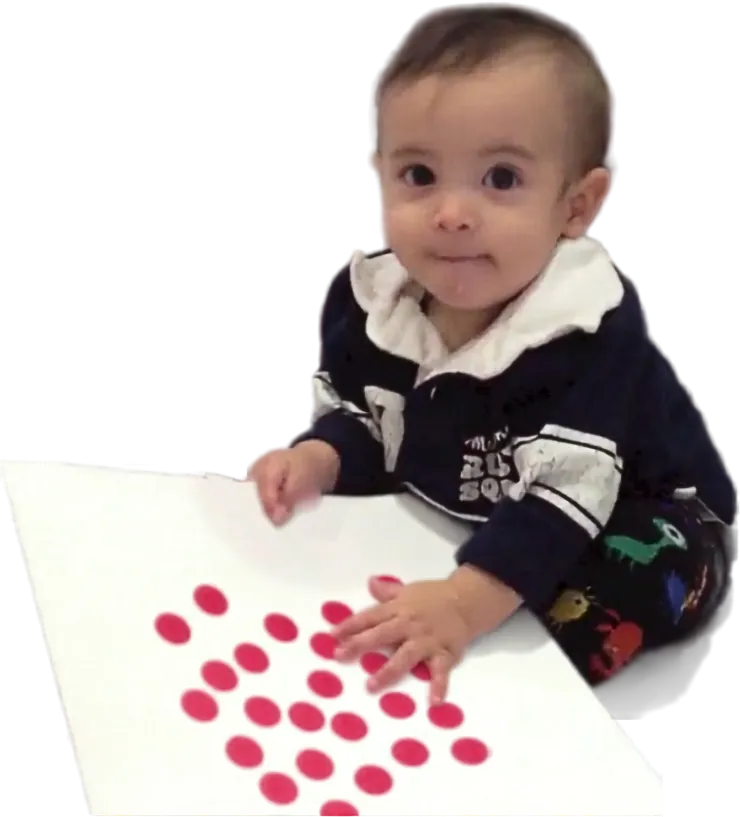
"The key word is Respect: for my baby, for the pace she grows at, and for everything she is capable of."
«La palabra clave es Respeto a mi bebé, a su ritmo de crecimiento y a sus infinitas capacidades.»
"It cleared up our doubts and showed us how much a baby's brain can do from day one. It also showed us what attachment parenting really means."
«Nos ayudó a quitarnos dudas y a entender el poder del cerebro de un bebé desde recién nacido. A entender lo que es la educación con apego.»
"We thought our daughter, at two and a half months, was too little for any of this. […] We left the workshop eager to begin."
«Pensábamos que para aplicar el método nuestra hija, de dos meses y medio, necesitaba estar más grande. […] Salimos del curso con muchas ganas de iniciar.»
The lessons
The seven linked stages that took me years to get into the right sequence: what to present, when to present it, and when to retire it. Each one sells on its own; together, they're the whole path.
The why before the how. It's what turns "I know what to do" into "I understand why it works."
And on top, these bonuses
Black-and-white silhouettes and a checkerboard to hang near the crib, for the first days. You start the day they're born, without waiting for the dots.
A private group of moms walking the same path. When it opens, you join as a founding member and it is already included.
For the day you decide your baby responds better to a physical card. Print whatever you want, in Letter or A4.
You save $71 USD — 71% off the total value.
Available very soon.
Seven interactive lessons, on a computer, tablet, or phone, plus the printable PDFs.
Try it for 14 days with your baby. If it doesn't feel right for your family, write to me at hola@papaspro.com and I'll refund your money.
Your baby's window is open. Every session you give them stays in the network their brain is building.
What would tonight feel like if you knew you'd already given your baby the opportunity?
Path 1
You save the page for the day you'll have time to make a hundred cards by hand and work all of this out on your own. That day comes when it comes, and meanwhile your baby keeps learning from everything they see.
Path 2
You start today with your baby. Thirty seconds, today's session ready, the tool carrying the tedious part and you present. Tonight you ask yourself —did I give full opportunity?— and the answer is yes.
How you start
You tap the button below.
You complete your purchase.
You sign in with your email and open the first session with your baby today.
Available very soon.
Instant access · 14-day guarantee
It's the opposite: the younger they are, the easier it is. Your baby's brain is at its most receptive —and their ability to see quantities, directly and without counting, is wide open in these very months, and narrows afterward.
That's why this path begins at birth. I'm doing it right now with my baby Rōki, from his first weeks —just as I did with my older kids. I've been at this for years, and I'm choosing it again. The bundle even includes a Visual Maturation lesson made for those first days.
There's no need to wait for them to "be ready." Starting today is starting with the window open.
It's the most important question you can ask yourself.
Glenn Doman put it plainly: the purpose of giving a child encyclopedic knowledge is not to make Nobel Prize winners, or concert violinists, or Olympic stars, or geniuses of any sort. It is to give them unlimited options in life.
This is gymnastics for the brain: you open the opportunity and let it grow at their own pace, no testing and expecting nothing of them. The opportunity is in your hands; the result is theirs.
And you're right to be concerned: sitting a little child down to do handwriting drills, to stay still at a desk, to take tests before their development asks for it does harm, and there's research behind it.
What we do here lives in another world: seconds a day, in your arms, playing.
It's joyful exposure, at their pace, woven into play and into being with you.
I get it —at first glance it looks that way. What's happening is lovelier: repetition gives your baby a lot of information, and with enough information a baby's brain does what it does best at this age —it works out the rule on its own.
You see it clearly when they learn to talk. One day your child says “I goed” instead of “I went.” It looks like a mistake, but it's the opposite: they grasped the rule for regular verbs (“I walked,” “I played”) and applied it to an irregular one. No one taught them that rule; they inferred it from listening. That's how they learn an entire language, with all its grammar, without a single class. Linguists call this overregularization; Steven Pinker explains it in depth in “Words and Rules.”
It's the same with quantities. Your baby sees the quantity itself —five dots, not the symbol “5”— again and again, and their brain begins to discover how they behave: that five plus two equals seven, without stopping to count. Some children solve operations on their own that no one ever showed them. That's grasping how numbers work —something most of us had to memorize as grown-ups.
There is no testing. Here we celebrate what is there.
When she was little, Zuri wanted to show me everything. Then one day she stopped —she'd felt tested, and held it in. My husband Luis would say "she's forgotten it all"; I'd say "no, relax." I kept presenting, without asking.
And at two, almost three, it came back: she saw some words and told me, "remember when you used to show me these? This says such-and-such." From then on, nothing stopped her —she read every street sign she saw.
That's why, at the end of the day, there's one question, the only one in your hands: "did I give them the opportunity today?"
Each session lasts seconds —under ten— and repeats a couple of times a day.
Time is the one thing a mom has least of. That's why the tool handles the material: you live those seconds present with your baby.
It's never too late to open an opportunity for your child.
What changes with the months is where you start: before 18 months, from the dots — subitization (perceiving quantities at a glance) is active. After 18 months that window closes, and your child goes straight into the numerals and operations stage, which runs all the way to fractions. The bundle includes both paths.
You don't need to be. You're already the expert on your baby: no one knows them more, or cares more, than you.
I tell you what to do each day and the tool carries the tedious part. You only bring what no one else can: your presence.
A physical card has something a screen doesn't: it's an object in your baby's hands.
And making one costs time, which is the thing we have least of. That's why the bundle includes both ways.
If you'd rather print everything and run it only on physical cards, you can: the PDFs are included. And the tool walks with you either way: you run the session on screen, or you mark that you did it on physical cards and it keeps track —which cards to pull, which you're showing, when to retire them.
And if one day you can't, that's fine. Don't freeze, and don't be hard on yourself. Here are both options; use them or combine them however works best for your family.
Interactive lessons you run on a computer, tablet, or phone.
Inside: the 7 core lessons (from dots to fractions) plus the Visual Maturation bonus, narrated in Spanish and in English —or in silent mode, so you can narrate them yourself, because a mom's voice will always be best.
Plus the Companion Guide (ES and EN) and 300+ printable cards in PDF (100 quantities, 100 numerals, and 120 equations), in Letter and A4.
You don't remember when you learned to walk or to talk, and yet you do both every day without thinking. You learned the deepest things before you had any memory at all, and that's why they became part of you forever.
Your baby may not remember these sessions, but they'll remember having you close.
And they'll use that brain highway their whole life, without knowing when it was built.
Available very soon.
Instant access · 14-day guarantee
P.S. What stays from these sessions is the love of learning, and they'll carry it long after they forget where it came from.